
What we are fighting against
Duchenne & treatment options
What Duchenne muscular dystrophy means, which mutation Constantin has, and which approved and new therapeutic approaches currently exist (as of November 2026).
The disease
What happens in the body with Duchenne muscular dystrophy
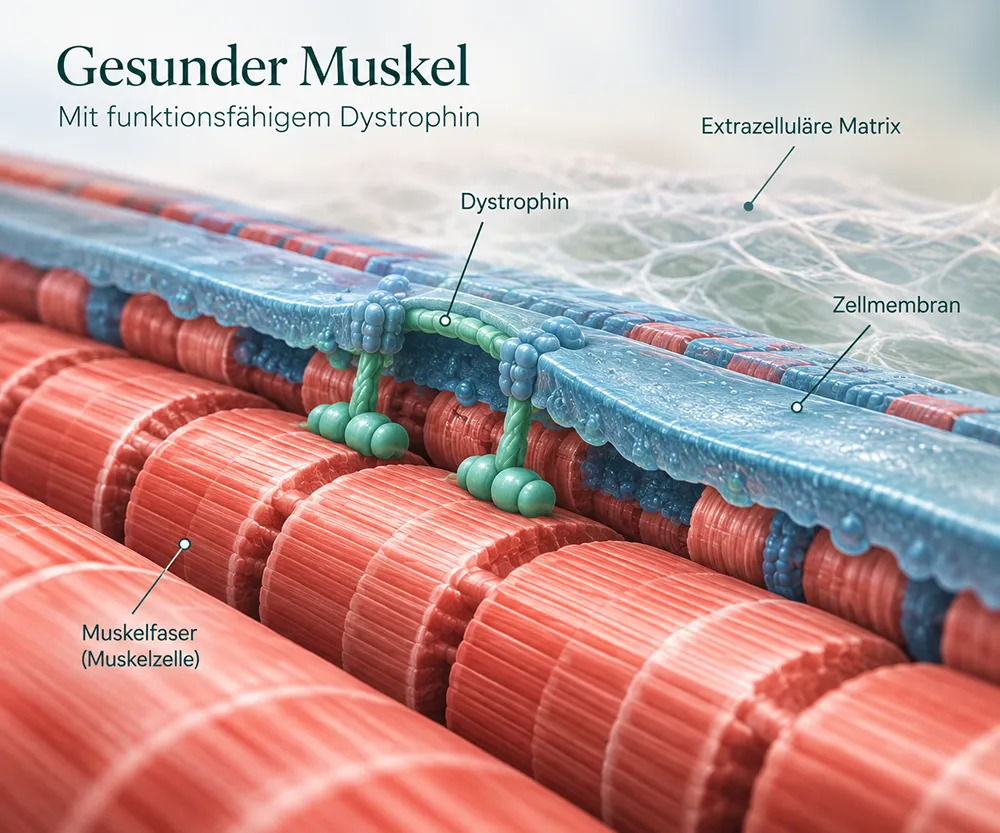
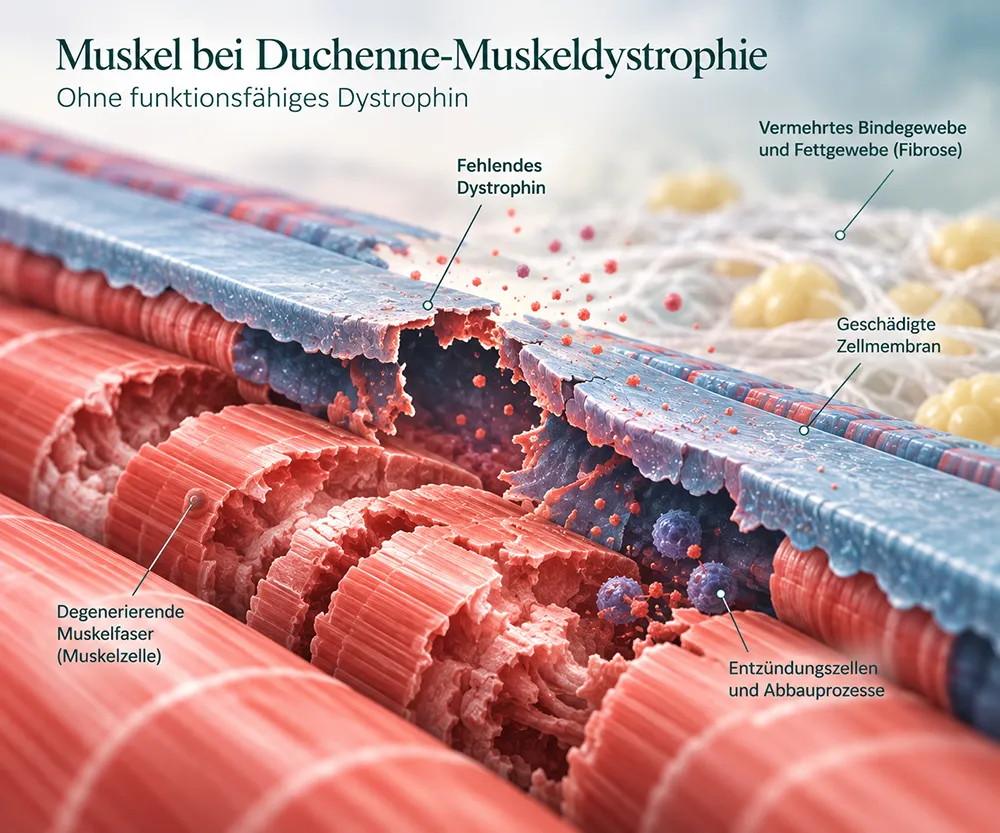
Duchenne muscular dystrophy is caused by a rare genetic mutation in the dystrophin gene that makes it impossible for the body to produce the vital protein dystrophin. Dystrophin is one of the longest protein molecules in the human body and acts much like a shock absorber for the muscle cells. It protects muscle cells from ageing too quickly and from premature cell death.
The dystrophin gene is located on the X chromosome. That is why a mutation affects almost exclusively boys: boys and men have only one X chromosome, so the male body cannot compensate for errors on it.
The dystrophin gene consists of 79 “exons” – individual sections of the genome, a bit like the chapters of a book. Mutations in this gene can take different forms:

Deletions: one or more sections are missing.
Duplications: a section is present twice.
Nonsense mutations: information has been inserted that the body cannot use.
Each of these mutations can occur at different places in the gene, but as a rule they always cause the production of the dystrophin protein to break off – and thus lead to the clinical picture of “Duchenne”.
Without dystrophin, muscle cells break down prematurely and die.
If the disease takes its natural course, affected boys lose the ability to walk at around 10–12 years of age and need a wheelchair. The disease usually starts in the leg muscles and then spreads to the rest of the body. Over time the arms also become weaker, and eventually the heart muscle and breathing are affected as well.
Sadly, if the disease takes its natural course, life expectancy is only about 20–30 years.
Constantin’s mutation
A very rare mutation
Our Constantin has a hemizygous single-base duplication in exon 27 – unfortunately a very rare variant. This means that a single base pair in this exon is present twice, which causes a frame shift and stops the production of the protein.

Treatment
Medicines currently approved in Austria
There are currently two approved drug therapies for Duchenne in Austria that can be used regardless of the underlying mutation. These are the medicines currently approved for Duchenne muscular dystrophy in Europe.
Together they extend the ability to walk by about 3-5 years and increase life expectancy by about 5–10 years.
Agamree / Vamolorone
This is a new type of corticosteroid that reduces the inflammatory reactions in the body caused by the damaged muscle cells.
At the same time it is better tolerated and has fewer side effects than earlier corticosteroids – above all, it is expected to cause less growth restriction.
Our Constantin has been taking it since the beginning of February 2026 and, fortunately, tolerates it well.
According to current estimates, Agamree delays the loss of the ability to walk by about 2 years.
Duvyzat / Givinostat
This is a very new medicine that was only approved in the EU in 2025.
It is an HDAC inhibitor that reduces inflammatory reactions, boosts muscle regeneration and slows down the conversion of muscle tissue into connective tissue.
Our Constantin has been taking this medicine since the end of October 2026 and, fortunately, has also tolerated it well so far.
According to current estimates, Duvyzat delays the loss of the ability to walk by about 3 years.
Everyday recommendations
In addition to these medicines, there are a number of recommendations, all of which we follow:

Night splints
To counteract the shortening of the tendons in his lower legs, he was given night splints that hold his feet at a 90° angle to his lower legs and that he is meant to wear overnight. Constantin wears them dutifully every night, without exception.
Physiotherapy & occupational therapy
Regular physiotherapy and occupational therapy are recommended to maintain mobility for as long as possible and to train and support the muscles.
Constantin loves his occupational therapy and physiotherapy sessions.
Regular swimming
There are indications that swimming every day supports the muscles and joints and helps maintain mobility for longer.
That is why, since the diagnosis, we have tried to go swimming at the nearest thermal spa as often as possible. But we never managed more than twice a week, and the costs were considerable.
Thanks to the support of an Austrian family, we were able to buy a swim spa for our garden in September 2026. Now our son really can swim in warm water every day.
Exercise
In general, Constantin should move as much as possible, but it is important not to overstrain him. Sore muscles are very harmful for him, so we always take his strength into account – whether he is skiing, cycling or swimming.



New therapeutic approaches
Important treatment options
Apart from the treatments described above, there are brand-new therapeutic approaches for Duchenne that are very promising.
First and foremost are gene therapies that produce micro-dystrophin. So far, one medicine of this kind has been approved in several countries – unfortunately not in the EU: Elevidys.
What all of these gene therapies have in common is that they are a one-time infusion of a genetically modified virus. This vector virus carries the genetic blueprint of a greatly shortened dystrophin into the body’s cells, which then start producing micro-dystrophin. Because the dystrophin gene is so large, it physically does not fit into vector viruses, so only a greatly shortened version can be delivered. This version is nevertheless functional, even if not as good as the original.
This therapy can be used for almost all mutations – Constantin would be eligible!
Besides Elevidys, further medicines using this technology are in development and close to approval, above all RegenxBio’s RGX-202 and Genethon’s GNT-0004.

Elevidys currently costs around €3.5 million and means a stay of about 5–6 months in the USA for the one-time treatment and follow-up care.
Exon skipping
The technology of exon skipping was discovered and researched in Japan in the 1990s. It teaches the body to skip the mutated exon of the dystrophin gene when producing the protein, so that the body can produce a slightly shortened but otherwise functional dystrophin.
The treatment has to be tailored exactly to the specific mutation and basically only works for exons where the end of the preceding exon is compatible with the beginning of the following one.
This is exactly the case for exon 27 (Constantin’s mutation), so it would be technically feasible.
Unfortunately, mutations in exon 27 are very rare, which is why there is currently no ready-to-use medicine for this mutation on the market. In Japan – the leading country in this technology – there are already exon-skipping medicines for mutations in exon 44 and above.
The drawback of this type of medicine is that it requires regular (weekly) infusions. The advantage, however, is that it can in principle be stopped if unwanted side effects occur.
We are currently trying to get in touch with researchers in Japan to find out whether a skipping medicine for exon 27 might come onto the market in the foreseeable future.
RGX-202 by Regenxbio – new hope for our Constantin
RGX-202 is also an experimental gene therapy that uses a harmless transport virus (AAV8) to deliver a micro-dystrophin gene into muscle and heart cells. The key difference from an already approved therapy such as Elevidys lies in the design of this so-called micro-dystrophin: RGX-202 contains a novel binding region (CT domain) that anchors the protein more firmly to the muscle cell wall and is therefore intended to offer potentially stronger protection against muscle breakdown. In addition, RGX-202 uses a specific control mechanism (the Spc5-12 promoter) that aims for targeted and strong production of the protein in both skeletal and heart muscle.
GNT-0004 by Genethon – hope through gene therapy
GNT-0004 is a gene therapy for Duchenne muscular dystrophy developed by Genethon. It uses the transport virus AAV8 to deliver a greatly shortened but fully functional micro-dystrophin gene directly into muscle and heart cells. Compared with Elevidys, GNT-0004 stands out for its specially optimised vector design, which is intended to produce a large amount of micro-dystrophin in the muscles with a considerably lower dose of the transport virus. This dose reduction is the key advantage, as it is expected to significantly lower the risk of severe immunological side effects and inflammatory reactions (such as irritation of the liver or heart) compared with high-dose AAV therapies like Elevidys.
SGT-003 by Solid Biosciences – advanced gene therapy
SGT-003 is a next-generation gene therapy by Solid Biosciences that delivers its own variant of the micro-dystrophin gene directly into the muscle cells. The key advantage over therapies like Elevidys lies in its novel, patented virus transporter (an AAV capsid called AAV-SLB101): it is specifically designed to target muscle tissue much more precisely and to bypass the liver. As a result, SGT-003 can reach the muscles more efficiently at a considerably lower total dose than Elevidys, which drastically reduces the risk of liver toxicity and immunological side effects. In addition, the micro-dystrophin produced by SGT-003 contains a so-called nNOS binding domain, which improves blood flow in the muscle during exertion and is thus intended to counteract rapid muscle fatigue.
Prime editing – (the cure in the distant future!)
Prime editing is a highly advanced gene-editing technique (a further development of the classic CRISPR/Cas9 “gene scissors”) that can precisely correct or rewrite DNA errors directly in the body’s own genetic material. The key advantage over therapies like Elevidys: instead of merely introducing a shortened “replacement gene” (micro-dystrophin) into the cell from outside, prime editing repairs the faulty blueprint of the original DMD gene precisely on the spot. This gives the technology the potential for the muscles to produce complete, natural dystrophin again, rather than just a shortened makeshift version. In addition, unlike the classic gene scissors, prime editing does not cut through both DNA strands, which drastically minimises the risk of unintended damage to the genome or dangerous mutations.
Status: For Duchenne, prime editing is currently (autumn 2026) at the preclinical research stage (laboratory and animal studies). It is therefore not yet a ready-to-use medicine, but scientists consider it one of the most promising approaches to a real cure that tackles the genetic cause.
SAT-3247 / Forazapadin by Satellos Bioscience
The approach of Satellos Bioscience (with the active substance SAT-3247 / Forazapadin) differs fundamentally from Elevidys and other gene therapies, as it is an orally taken medicine (tablet) rather than a gene transfer.
The active substance does not repair the genetic defect itself, but acts on the body’s own muscle regeneration: in Duchenne, the missing dystrophin also disrupts the division of muscle stem cells, which is why destroyed muscle no longer grows back. SAT-3247 blocks a specific protein (AAK1), restores the signal for stem cell division and stimulates the body to build new muscle mass by itself.
The key advantage over Elevidys lies in its independent mode of action and simple use: since SAT-3247 works completely independently of the type of mutation and does not use viruses, there is no risk of severe viral immune reactions, it does not have to be given as a one-time infusion, and it could potentially be combined ideally with gene or exon-skipping therapies.
Deramiocel (CAP-1002) by Capricor
Deramiocel (also known as CAP-1002) by Capricor Therapeutics differs fundamentally from Elevidys and classic gene therapies, as it is a cell-based immune and tissue therapy. Processed heart cells from donors (allogeneic cells) are given by regular infusion; they release messenger substances that reduce inflammation and slow down muscle scarring (fibrosis).
The key advantage over gene therapies lies in its effect on the heart and its suitability for older and non-ambulatory patients: while Elevidys is mainly intended to slow the loss of the ability to walk, Deramiocel specifically targets the preservation of arm and hand function (upper-body strength) and the stabilisation of the heart muscle. In addition, Deramiocel requires no genetic modification and no AAV virus vector, so it can be used regardless of the mutation – including for boys who are no longer eligible for Elevidys because of immunity or advanced age.